
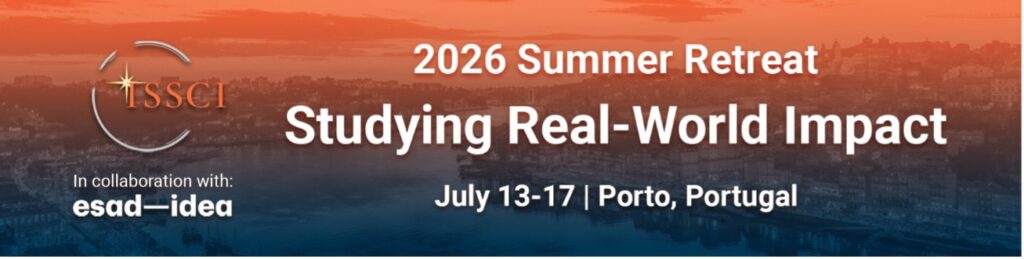
2026 Summer Retreat Studying Real-World Impact
By now you know about the ISSCI Summer Retreat, and we have had a great response. People have applied from many parts of the world. It’s going to be a fascinating group!
There are a few places still available so we have extended the deadline until April 30.
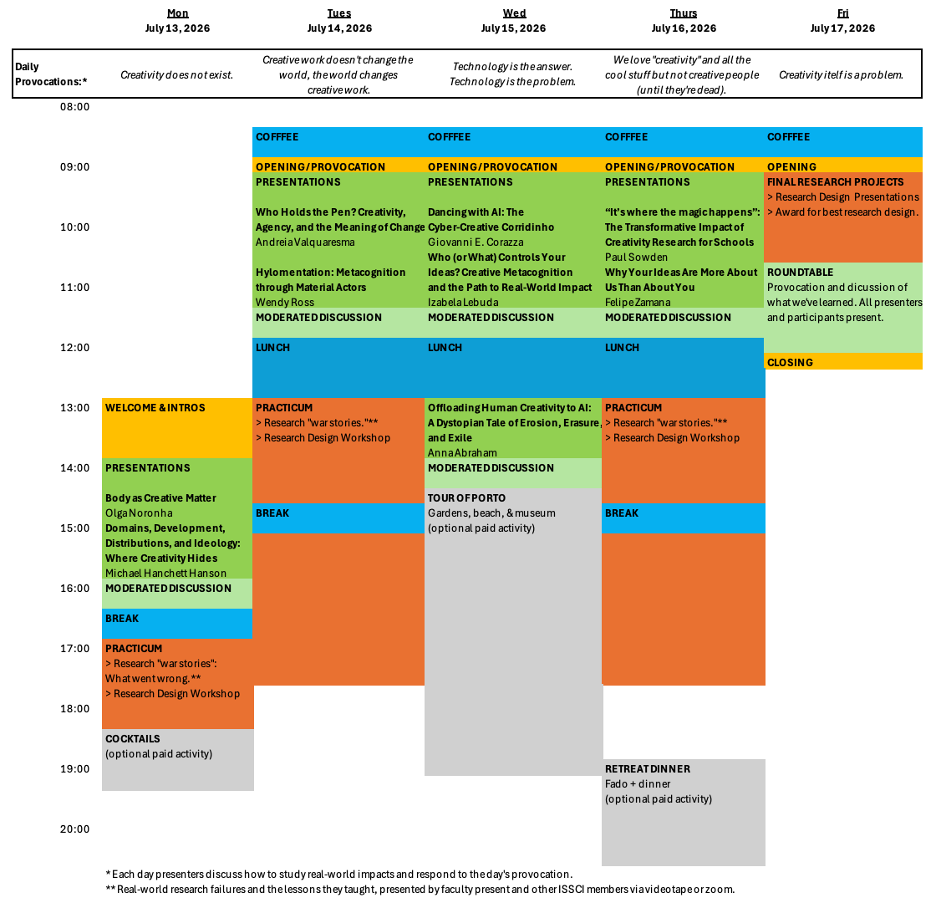
Program
Why join the retreat?
- Engage in in-depth discussions in a small, highly interactive forum.
- Learn about leading-edge research from diverse theoretical perspectives and methodological approaches.
- Participate in hands-on workshops for designing research on real-world impact, bridging creativity research and practical application.
- Compete for the Best Research Design Award (800€).
Participation Requirements
Limited space. Participation by application.
To ensure productive discussion and meaningful collaboration, all applicants must meet the following criteria:
- Researcher, practitioner, or graduate student currently working on creativity or innovation who is not an ISSCI member but is sponsored by a member.
- Provide CV and a short statement of background and interest in exploring the real-world impacts of creativity and innovation.
- If you have a current research design that you would like to enhance or extend, provide a short description of the study (optional).
Selection Process
Applications will be reviewed by the Organizing Committee. Selection will aim to ensure a diverse group of participants, including doctoral students, postdoctoral researchers, and experienced scholars.
Costs
Thanks to the generous support of ISSCI and esad—idea, participation in the retreat is free(!) for accepted applicants. Participants only need to cover the expenses of their own travel and accommodation.
Suggested accommodations will be provided with your Retreat Acceptance notification.
Presenters
Anna Abraham is the E. Paul Torrance Professor and Director of the Torrance Center for Creativity at the University of Georgia (UGA), USA. Dr. Abraham investigates the psychological and neurophysiological mechanisms underlying creativity and other aspects of the human imagination, including the reality-fiction distinction, mental time travel, social and self-referential cognition, aesthetic experience, and mental state reasoning. She is a Fellow of the Royal Society for the Encouragement of Arts (RSA, UK), the Higher Education Academy (HEA, UK), and the Salzburg Global Seminar (SGS, Austria). She is also an Expert Advisory Board Member at the Centre for Arts and Social Transformation (University of Auckland, New Zealand) and serves as a Scientific Advisory Board member for the Max Planck Institute for Empirical Aesthetics (Frankfurt, Germany: 2024-2029). She is the Founding Editor of the Cambridge Elements in Creativity and Imagination – an academic short book series. She has penned numerous publications including the 2018 book, The Neuroscience of Creativity (Cambridge University Press), and 2020 edited volume, The Cambridge Handbook of the Imagination. Her latest book is The Creative Brain: Myths and Truths (2024, MIT Press).
Giovanni Emanuele Corazza is a Full Professor at the Alma Mater Studiorum University of Bologna, founder of the Marconi Institute for Creativity (MIC), Core Faculty Member of the Bologna Business School (BBS), Member of the Board of the International Society for the Study of Creativity and Innovation (ISSCI), Leader of the ISSCI AI Task Force. He holds a PhD in Telecommunications and Microelectronics from the University of Rome Tor Vergata, and a PhD in Psychology from the Université Paris Cité. His research interests are focused on creativity studies, Gen-AI, cyber-creativity, anticipation, next generation telecommunications. He was President of the Fondazione Guglielmo Marconi in the years 2019-2023, President of the CINECA consortium for supercomputing in the years 2017-2019, Head of the Department of Electronics, Computer Science and Systems (DEIS) in the years 2009-2012, Member of the Partnership Board of the 5G Infrastructure Association in the years 2013-2018, Member of the Board of Directors of the University of Bologna in the years 2012-2018, Chairman of the School for Telecommunications in the years 2000-2003, Chairman of the Advanced Satellite Mobile Systems Task Force (ASMS‑TF), Founder and Chairman of the Integral Satcom Initiative (ISI), a European Technology Platform devoted to Satellite Communications.
Michael Hanchett Hanson is a developmental psychologist specializing in lifespan creative development, with a BA in architecture from Yale University and his PhD in developmental psychology from Columbia Univeristy. He teaches creativity theory and case-study methods at Teachers College, Columbia University and is a Member of the Chair Homo Creativus, Fondation de l’Université de Paris Cité. He is a founding ISSCI board member and currently Chair of the ISSCI Education Committee; Executive Editor of the Routledge Creativity in Practice series; and President of Contexts R+D Inc. Michael is one of the leading researchers contributing to the participatory creativity framework which looks at development of creativity as socially, materially, and temporally distributed in complex systems. He has conducted research and consulted on curriculum design, content development and program evaluation for arts organizations, youth development programs, individual schools, boards of education and corporations. He has written on educational practices, the history of the construct of creativity within psychology, the ideological uses and dangers of the construct, relations of creative work to power dynamics, creative practices in the construction of the self, and the pros and cons of educators’ use of the idea of creativity.
Izabela Lebuda is a psychologist and educator, associate professor at the Creative Behavior Lab, Institute of Psychology, University of Wrocław, Poland. In her research, she focuses on creative metacognition, creative self-beliefs, and personality characteristics related to creative achievement. She received the 2022 Berlyne Award in recognition of outstanding research by a junior scholar from the Division of the Psychology of Aesthetics, Creativity, and the Arts of the American Psychological Association, and in 2025 she was recognized as a Rising Star in creativity research by the ISSCI. She is a co-editor of the journal Creativity. Theories – Research – Applications.
Olga Noronha, visual artist, designer and researcher, has a PhD from Goldsmiths College, University of London. She is associated with various national and international academic institutions, such as the Royal College of Arts (UK), Central Saint Martins College of Art and Design (UK), Winthrop University (USA), UCA Rochester (UK), POLIMI (IT), ESAD (PT); among others. Olga is a curator at the Museo Del Gioiello Vicenza, in Italy, and Coordinator and Principal Investigator of the project funded by the Foundation for Science and Technology (FCT), entitled “Study of filigree patterns for applications in biomedical jewellery” [www.biofiligree.com]. With multiple national and international exhibitions and publications in the fields of art, design and science, Olga Noronha’s work is included in several public and private collections, including MuDe – Museum of Design and Fashion, Museo Del Gioiello Vicenza and Fundação de Serralves.
Wendy Ross is a cognitive psychologist who teaches across our psychology courses at London Metropolitan University. Wendy’s main topic of research is the role of material serendipity in higher cognitive processes such as insight problem solving and creativity. She draws on a range of methods from eye-tracking and experimental psychology to focused cognitive ethnography. Her current focus is the interaction between individual differences in behaviour (particularly those associated with different neurotypes) and the material affordances of the environment. She is a founding member of the Possibility Studies Network and Associate Editor at Possibility Studies and Society and Creativity Research Journal. She has won competitive funding from The British Academy and the ESRC as well as working on ERC funded projects.
Paul Sowden is Professor of Psychology, Creativity & Cognition, University of Winchester, UK and Visiting Professor of Cognition & Creativity, University of Surrey, UK. He began his research career as a lab-based cognitive psychologist conducting research focused on visual perception, attention and categorisation. Starting in 2009, he began working on creativity, especially creative cognition and thinking processes. Paul has mapped the relationship between dual process models of cognition and models of creative thinking. He has also translated models of creative thinking into education settings to help educators and students develop creative competencies across the curriculum. Amongst other work, this has involved working with the OECD on Creativity and Critical Thinking and leading a five-year ‘Creativity Collaborative’, funded by Arts Council England and the Freelands Foundation, working with 16 schools to introduce teaching for creativity across the curriculum. His forthcoming co-edited Handbook of Creativity in Schools will be published by Edward Elgar later in 2026.
Andreia Valquaresma, University of Maia, Portugal, is a psychologist, researcher, and university lecturer whose work sits at the intersection of creativity, agency, and human development. Based in Portugal, she holds a PhD in Psychology from the University of Porto and has built a sustained research trajectory around the role of creativity in navigating the complexities of contemporary education and society. She has published in international journals and edited volumes, and her work spans from creative self-efficacy and aesthetic judgment to meaning-making and curricular reform. Beyond academia, Andreia brings to her work a background in the arts that quietly shapes her conviction that creativity is not a luxury, but a fundamental human capacity worth taking seriously.
Felipe Zamana is an educator, writer, speaker, and researcher specializing in creativity, education, leadership, and the future of work. He holds a PhD in Psychology from Université Paris Cité (Paris V – Sorbonne). His work focuses on bridging academic knowledge and professional practice across education and organizational contexts, supporting students, educators, and decision-makers in applying research to real-world challenges. He designs and delivers lectures, courses, and workshops for universities, companies, and international organizations, including the World Bank Group and the OECD. Felipe’s research draws on complex systems theories to explore the creative processes behind knowledge-building, with a focus on how participatory dynamics connect individuals and shape creative ecosystems. He is the author of several international academic publications, and his book Taking Creativity Seriously was nominated for the Jabuti Award, Brazil’s Oscar of Literature. As a writer, he tackles topics that challenge conventional wisdom and encourages professionals to think more deeply about the implications of their work.